
Key Takeaways:
- Startups owing $1,000+ in federal taxes must make quarterly estimated payments to avoid penalties.
- The self-employment tax rate is 15.3% on net earnings, catching many first-time founders off guard.
- Safe harbor rules protect you from penalties even when income spikes unexpectedly.
- The 2026 quarterly deadlines aren’t actually quarterly—they create uneven payment periods.
- Strategic tax planning throughout the year beats scrambling at filing time.
You launched your startup to build something meaningful. Now you’re dealing with quarterly estimated taxes.
At Michael Dolezal & Co, we work with high-growth startups throughout Northeast Ohio and beyond. We’ve seen how quarterly tax obligations can blindside founders who are focused on product development, customer acquisition, and fundraising. The good news? Understanding the system helps you plan ahead and avoid expensive surprises.
What Are Quarterly Estimated Taxes?
Quarterly estimated taxes are payments you make to the IRS throughout the year on income that doesn’t have taxes withheld. For startups, this typically includes:
- Business profits from your LLC, S-corp, or partnership
- Self-employment income if you’re a sole proprietor
- Investment income and capital gains
- Contract work and 1099 income
The IRS expects you to pay taxes as you earn income. If you wait until April to pay everything, you’ll face underpayment penalties.
The $1,000 Threshold That Catches Founders
Here’s the rule: startups owing $1,000 or more in federal taxes must make quarterly estimated payments. This applies even if you’re due a refund when you file your annual return.
For corporations, the threshold drops to just $500.
Many founders assume refunds protect them from penalties. They don’t. The IRS calculates penalties separately for each quarterly period. You can’t retroactively eliminate penalties from earlier quarters by overpaying later in the year.
Understanding the Self-Employment Tax Shock
First-time entrepreneurs often underestimate the self-employment tax obligation.
The rate is 15.3% on net self-employment earnings, according to the IRS self-employment tax guidelines. This breaks down into:
- 12.4% for Social Security (on the first $184,500 of net earnings in 2026)
- 2.9% for Medicare (on all net earnings)
- An additional 0.9% Medicare surtax above $200,000 (single) or $250,000 (married filing jointly)
When you work for someone else, your employer pays half of these taxes. When you work for yourself, you pay both halves.
This catches founders off guard. You might think you’re in the 24% federal tax bracket, but you’re actually paying closer to 39% when you add self-employment tax.
The 2026 Quarterly Payment Schedule
The quarterly deadlines aren’t actually quarterly. They create uneven payment periods that confuse many startup founders.
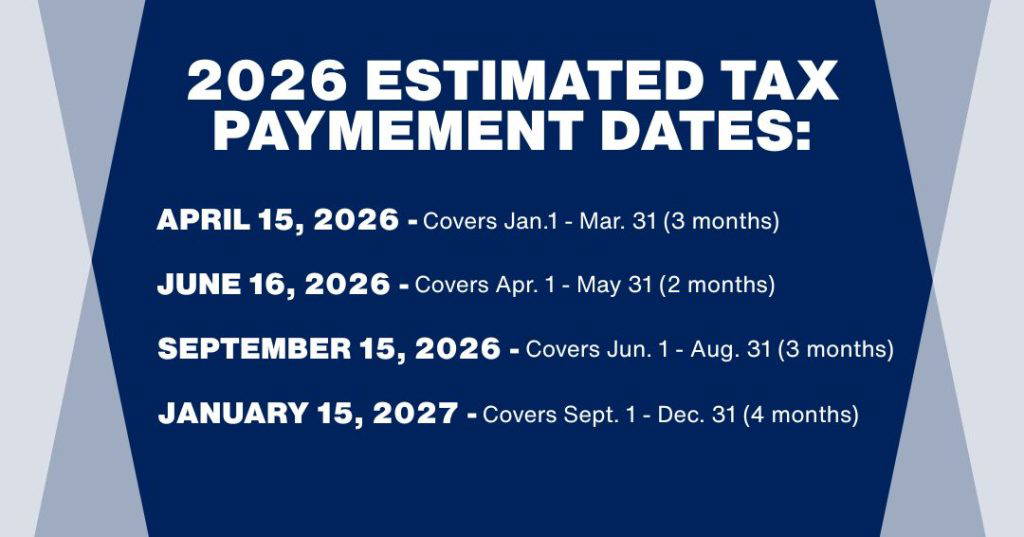
Notice the irregular structure. The first period covers three months, the second covers just two months, the third covers three months, and the fourth covers four months.
This irregular timing matters when you’re calculating how much to pay each quarter.
How Penalties Work (And How to Avoid Them)
Underpayment penalties start at 0.5% of the total amount due per month and can reach a maximum of 25%. As of Q1 2026, the IRS underpayment penalty rate is approximately 7% annually, compounded daily.
The penalties add up fast. A $10,000 underpayment for one quarter costs you roughly $175 in penalties.
Safe Harbor Protection for Volatile Income
Safe harbor rules protect you from penalties even when your income spikes unexpectedly.
You avoid underpayment penalties by paying either:
- 90% of the current year’s tax liability, or
- 100% of the prior year’s tax (110% if your adjusted gross income exceeded $150,000)
This protection is valuable for startups with unpredictable revenue growth. You’re protected from penalties even if your income skyrockets mid-year, though you’ll still owe the balance at filing time.
Example: Your startup had $50,000 in taxable income last year and paid $15,000 in taxes. This year, you land a major contract, and your income jumps to $200,000. As long as you pay at least $15,000 in quarterly estimated taxes (100% of last year’s tax), you won’t face penalties—even though you’ll owe significantly more when you file.
The Annualized Income Method for Seasonal Startups
Startups with lumpy or seasonal income can use the Annualized Income Installment Method (Form 2210 Schedule AI) to match payments to when income actually arrives.
This method allows smaller quarterly payments during low-revenue periods without triggering underpayment penalties.
It’s particularly valuable for:
- B2B SaaS companies with large Q4 contracts
- Seasonal e-commerce businesses
- Startups with irregular revenue patterns
The annualized method requires more detailed record-keeping, but it can save you thousands in unnecessary quarterly payments when cash flow is tight.
R&D Tax Credits: Turning Compliance Into Cash Flow
Qualified small businesses founded within the past five years with less than $5 million in revenue can apply up to $500,000 of R&D credits against payroll taxes each year.
This provides immediate cash flow benefits for pre-revenue startups with minimal income tax liability. You’re turning tax compliance from purely a cost center into a potential funding source.
Many startups overlook this opportunity because they assume R&D credits only apply to large companies or traditional research labs. Software development, product testing, and process improvements often qualify.
Multi-State Obligations for Remote Startups
After the 2018 South Dakota v. Wayfair Supreme Court decision, more than 45 states enforce economic nexus standards based solely on sales volume.
Most states set the threshold at $100,000 in annual sales.
Even fully remote SaaS or e-commerce startups may trigger nexus (the tax obligation you create by doing business in a state) without realizing it. This requires quarterly estimated payments in multiple states simultaneously.
You might think you only owe taxes in your home state. But if you’re selling to customers across state lines, you could have tax obligations in every state where you exceed the economic nexus threshold.
How Tax Compliance Affects Fundraising
Tax compliance gaps have outsized effects on startup valuations during fundraising.
Investors apply valuation haircuts to cover potential tax exposure. One example showed a startup expecting a $50 million valuation dropped to $40 million simply because tax liabilities were unclear.
Funding rounds can stall for months while advisors quantify tax risks. This erodes runway and momentum at the worst possible time.
Clean tax records signal operational maturity to investors. Messy tax situations signal risk.
Tax Planning vs. Tax Preparation
Tax planning happens throughout the year. Tax preparation happens once a year.
Planning helps you:
- Optimize your entity structure (LLC vs. S-corp vs. C-corp)
- Time income and expenses strategically
- Maximize deductions and credits
- Avoid penalties through proper quarterly payments
- Maintain clean records for due diligence
Preparation just files what has already happened.
Most startups need planning, but they only get preparation. This costs them money and creates unnecessary stress.
Common Mistakes Startup Founders Make
- Waiting until April to think about taxes. By then, you’ve missed opportunities to optimize your tax position, and you’re scrambling to find cash for a large tax bill.
- Mixing personal and business expenses. This creates accounting nightmares and raises red flags during audits or due diligence.
- Ignoring state tax obligations. Many founders focus on federal taxes and forget about state income taxes, sales taxes, and franchise taxes.
- Underestimating quarterly payments. It’s tempting to pay less now and deal with it later. But penalties compound, and cash flow problems get worse.
- Not tracking deductible expenses. You’re leaving money on the table if you’re not capturing all legitimate business expenses throughout the year.
Building a Year-Round Tax Strategy
Effective tax planning integrates with your overall business strategy.
Start by setting aside money for taxes as you earn it. A simple rule: put 25-30% of your net income into a separate tax savings account. This ensures you have cash available when quarterly payments are due.
Review your numbers monthly. You don’t need a full financial close, but you should know roughly where you stand on revenue, expenses, and profitability. This helps you adjust quarterly payments if your income changes significantly.
Work with an advisor who understands startups. Generic tax advice doesn’t account for equity compensation, fundraising implications, or growth-stage cash flow challenges.
Document everything. Good records make tax time easier and protect you during audits. They also make due diligence faster when you’re raising capital.
Frequently Asked Questions
Do I need to make quarterly payments in my first year of business?
Yes, if you expect to owe $1,000 or more in taxes. Many founders skip this in year one and face penalties. The IRS doesn’t give you a grace period for being new.
What happens if I miss a quarterly payment deadline?
You’ll owe penalties on the underpayment for that quarter. The penalty compounds daily until you pay. You can’t eliminate it by overpaying in later quarters.
Can I adjust my quarterly payments if my income changes?
Yes. You should adjust payments when your income changes significantly. The safe harbor rules protect you as long as you meet the minimum thresholds, but you’ll owe the balance at filing time.
How do I calculate my quarterly payment amount?
Start with your expected annual taxable income. Calculate your total tax liability (including self-employment tax). Divide by four. Adjust for the uneven quarterly periods if needed. Or use the prior year safe harbor method for simplicity.
Should I pay more than the minimum to avoid a large tax bill in April?
It depends on your cash flow. Paying more throughout the year smooths out your cash needs and eliminates surprises. But if cash is tight, meeting the safe harbor minimum protects you from penalties while preserving working capital.
Get Strategic About Your Taxes
Quarterly estimated taxes don’t have to be a source of stress. The key is treating taxes as part of your overall financial strategy, not just a compliance obligation.
At Michael Dolezal & Co, we help high-growth startups build year-round tax strategies that minimize liabilities, protect cash flow, and position you for successful fundraising.
Ready to get strategic about your taxes? Schedule a free consultation with our team to review your situation and identify opportunities you might be missing.