5 Signs Your Business Has Outgrown Your Bookkeeper

Your bookkeeper keeps your books clean. They track what came in and what went out, and they make sure payroll runs on time and tax deadlines don’t sneak up on you. But they don’t tell you what your numbers mean.
You’ve got accurate reports, and you know your revenue and expenses, but when it’s time to decide whether to expand, hire another employee, or raise your prices, you’re working from gut instinct instead of financial analysis.
That’s the gap.
A bookkeeper records what happened. A CFO helps you plan what happens next. If you’re feeling that gap widen, you’re not alone. Demand for fractional CFOs has surged 103% in the last year alone.
Here are five signs you’ve outgrown your bookkeeper and need strategic financial leadership.
1. You're Making Big Decisions Without Financial Analysis
Your books are current, and your reports are accurate. But when you need to decide whether to take on a new project, lease equipment, or open a second location, you’re guessing. If you don’t have visibility into cash flow projections or know your profit margins by service line, then you can’t model what happens if revenue dips 15% next quarter.
Bookkeepers track yesterday’s money. CFOs shape tomorrow’s growth.
If you’re spending more than two hours a week in spreadsheets trying to figure out your finances, that’s a red flag. You should be focused on running your business, not decoding your own numbers.
2. You've Hit $500K to $1M in Revenue
This is the threshold where financial complexity jumps.
You’re managing more vendors and have employees or contractors to pay. Your tax situation is more complicated. You need to understand working capital, not just whether you can cover next week’s bills.
Most businesses should consider a fractional CFO when revenue reaches $500,000 to $1 million. The sweet spot is $1 million to $3 million in revenue.
At this stage, you need someone who can tell you what your numbers mean for the next two years, not just what they were last month.
3. Cash Flow Feels Unpredictable
You’ve had months where revenue looked great on paper, but you couldn’t make payroll without scrambling. Or you’ve turned down opportunities because you weren’t sure if you had the cash to support them.
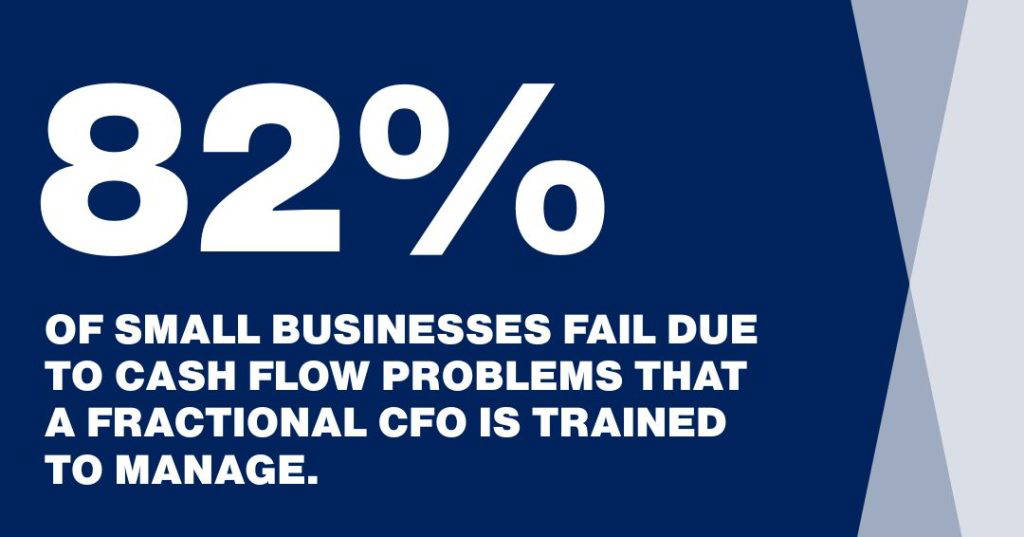
Bookkeepers record transactions. They don’t forecast cash flow or help you understand your burn rate. They don’t build financial models that show you when to hire, when to hold, and when to invest.
If cash flow feels like a mystery, you need more than bookkeeping. You need a strategy.
4. You're Growing Fast, and It Feels Chaotic
Growth is good; unmanaged growth is dangerous.
When your revenue is climbing 50% or more annually, your financial operations need to keep pace. You need real-time visibility into profit margins, cash flow, and tax liability.
You need someone who can help you scale without breaking your business and who can tell you whether you can afford to hire three more people or if you should wait six months.
Rapid growth increases financial complexity. Without strategic guidance, you can grow yourself into a corner.
5. You're Preparing for a Major Transition
If you’re getting ready for a major transition in your business, such as raising capital, planning an exit, or a merger or acquisition, you need more than just clean books. These transitions require financial strategy, projections, and someone who can speak the language of investors, lenders, and buyers.
A bookkeeper can’t prepare you for due diligence. A CFO can.
The Solution: Fractional CFO Services
If your revenue is below $3 million, you probably don’t need a full-time CFO. Most businesses at this stage don’t.
What you need is access to CFO-level expertise without the $250,000+ salary and benefits package. That’s where fractional CFO services come in.
A fractional CFO gives you strategic financial leadership on a flexible basis. You get the experience, the analysis, and the guidance without the full-time commitment.
Companies that hire fractional leadership see a 15% reduction in wasted operational spending within the first six months. You save 60% to 80% compared to hiring a full-time CFO.
This doesn’t mean replacing your bookkeeper; you need both. Bookkeeping provides accurate data, while a CFO services turn that data into strategic guidance.
How Michael Dolezal & Co. Works as Your Fractional CFO
We’ve spent 20+ years helping businesses make sense of the numbers and develop an action plan. We know what it looks like when a business outgrows its bookkeeper because we’ve guided dozens of companies through that transition.
Here’s what we do as your fractional CFO:
- Cash flow forecasting and management, so you know what’s coming before it becomes a problem
- Financial modeling and scenario planning to help you make decisions with confidence
- Strategic tax planning that goes beyond compliance and into optimization
- Real-time financial reporting that shows you what matters, not just what happened
- Business advisory that helps you see around corners and plan for growth
We work around your schedule and your budget. You get access to CFO-level expertise without hiring a full-time executive.
And we integrate with your existing bookkeeper. We’re not here to replace your team, but rather to elevate your financial strategy.
You Deserve More Than Compliance
Your business has grown, and so have your financial needs. You deserve more than clean books and filed tax returns; you deserve a strategy you can actually use.
If you’re seeing these signs, it’s time to talk.
We’ll help you understand where you stand, what your numbers mean, and what to do next. No jargon. No pressure. Just straight answers from someone who’s been doing this for two decades.
Schedule a free consultation with Michael Dolezal & Co. Let’s talk about your accounting, bookkeeping, and fractional CFO needs. We’ll tell you exactly what you need and what you don’t.
Your numbers should tell you something. We make sure they do.